Thursday, May 22, 2014
Exciting! New Meteor Shower Camelopardalids
Go to bed early Friday night and set your alarm for the wee hours, as we have a brand new meteor shower coming our way. When we pass through the old dust trails left by Comet 209P/LINEAR, the radiant will appear to be in the constellation Camelopardalis, hence the name of the shower Camelopardalids. I'll be honest, I wasn't familiar with Camelopardalis until now. It lies in the northern sky between Ursa Minor, Ursa Major and Cassiopeia. Thus, this is prime viewing for us northerners. This shower will peak around 3:00 AM 5/24/2014, and from what I'm reading is going to be short lived. According to this Wikipedia article, there may be 100 to 400 MPH! I hope you have clear skies!

Tuesday, October 8, 2013
Sun Dog
This photo was quickly taken while I was mowing my lawn. This is a sun dog.


I often look for these and find them to be more common than I once thought. Typically you'd spot a sun dog as the sun is close to the horizon, but I have seen them higher in the sky. Notice the cirrus clouds; this is key for the creation of a sun dog. The sunlight is refracted through the high altitude ice crystals within the cirrus clouds, and bright 'mock suns' are created 22° on either side of the sun.
Here I've circled the sun dog for easy identification..

Sun dogs are beautiful atmospheric phenomenon, and fun to spot. Start looking out and I'm sure you'll see one soon.
Tuesday, January 8, 2013
A New Year
Ah, a new year is here. It's time to be re-inspired. Take on new goals and chart new adventures. Most of the time, and especially with cold nights, I'm content with a few minutes outside. I'll check the cloudiness, spot a few constellations and other naked eye visible objects; M31, planets, satellites, etc. Lately taking the time to set up and take down my observing equipment has been a bit off-putting. The solution to this is going to be better organization. I'm consolidating accessories into a single box, I've purchased a new finder scope (the Orion 9x50 RACI) for easier spotting and a green laser (which I may or may not mount, but will be great for pointing with others present), I also plan to put together a new observing chair.
Tonight's sky was pretty clear, so I got myself excited to head out. I decided I'd take another stab at shooting the Orion Nebula with my DSLR. I set the camera on a tripod with a 210 mm lens and connected it to my laptop via USB in order to use a remote shutter program called SM Tether. This software allows me to do a much better job at adjusting the focus and shutter speed since I can preview each image on the laptop immediately after taking the photo. So here's my official first shot: 1:48 exposure time from 54 frames.

Tonight's sky was pretty clear, so I got myself excited to head out. I decided I'd take another stab at shooting the Orion Nebula with my DSLR. I set the camera on a tripod with a 210 mm lens and connected it to my laptop via USB in order to use a remote shutter program called SM Tether. This software allows me to do a much better job at adjusting the focus and shutter speed since I can preview each image on the laptop immediately after taking the photo. So here's my official first shot: 1:48 exposure time from 54 frames.

Tuesday, June 5, 2012
Observing the Venus Transit
So, for most of us the window for observing the transit of Venus has passed. I began by watching the live stream on CosmoQuest with Phil Plait, Fraser Cain, Pamela Gay & co. Watching Venus enter the Sun's disk was pretty exciting. Thankfully it wasn't long before the clouds above my sky broke, and I made a dash for my binoculars. Bonus - in addition to satisfying my personal desire to see the transit first hand, I was able to share it with my wife, daughter and a friend who had never even considered the thought of observing the sun, especially not with binoculars! The projection through my binoculars was quite successful. I don't have a proper mount for my tripod, so I had to hold the glass steady. The fact that my house faces west meant I was able to project right on to my white siding - perfect!
Pictured here on the left is myself trying to hold the binos steady (not easy). To the right is the resulting projection. Not bad! You can easily see Venus on the lower right of the Sun's image. The shadows along the northern part of the sun are from the local clouds.


If you didn't have an opportunity to see this event for yourself, I'm sure the internet will be full of recorded streams and images for your viewing pleasure. I believe you can find CosmoQuest recordings here, and NASA data here.
Pictured here on the left is myself trying to hold the binos steady (not easy). To the right is the resulting projection. Not bad! You can easily see Venus on the lower right of the Sun's image. The shadows along the northern part of the sun are from the local clouds.


Below is a close up of the projected image. I increased the contrast for easier viewing. Very cool!

Tuesday, May 22, 2012
Transit of Venus
Hey! Be sure to mark your calendar for June 5th and 6th to see the historic transit of Venus. This will be the last one of your lifetime, as the next transit will be in December 2117. You can check your local transit times here.
The transit of Venus occurs when Venus passes through the same orbital plane as Earth, thus enabling us to see it cross in front of the Sun (rather than above or below it). This is the same concept as the Moon eclipsing the Sun. This alignment occurs only every 243 years, with pairs of transits occuring 8 years apart (2004 was the last one) seperated by 121.5 and 105.5 year gaps.
Observing The Transit
First of all, never look direcly at the sun without proper eye protection. There are a few different ways you can go about observing the sun. The simplest and least expensive method would be some sort of projection. I won't go into all the details, but you can make a pinhole projector or project through a lens. You can use this technique if you have binoculars. (Never look at the sun through binoculars unless you have approved solar filters attached to the binoculars.) Hold the binoculars steadily pointed at the sun and a sheet of paper some distance away from the eyepiece on which to focus the sun's disc. This method is best if you have a way to secure the binoculars in position so the image is not constantly moving in and out of focus from your moving arms - trust me. It's also a great way to share the view with others. Me personally, I'll be projecting through binoculars. You can read more about these methods at spaceweather.com
Enjoy the event, and clear skies to you!
The transit of Venus occurs when Venus passes through the same orbital plane as Earth, thus enabling us to see it cross in front of the Sun (rather than above or below it). This is the same concept as the Moon eclipsing the Sun. This alignment occurs only every 243 years, with pairs of transits occuring 8 years apart (2004 was the last one) seperated by 121.5 and 105.5 year gaps.
Observing The Transit
First of all, never look direcly at the sun without proper eye protection. There are a few different ways you can go about observing the sun. The simplest and least expensive method would be some sort of projection. I won't go into all the details, but you can make a pinhole projector or project through a lens. You can use this technique if you have binoculars. (Never look at the sun through binoculars unless you have approved solar filters attached to the binoculars.) Hold the binoculars steadily pointed at the sun and a sheet of paper some distance away from the eyepiece on which to focus the sun's disc. This method is best if you have a way to secure the binoculars in position so the image is not constantly moving in and out of focus from your moving arms - trust me. It's also a great way to share the view with others. Me personally, I'll be projecting through binoculars. You can read more about these methods at spaceweather.com
Enjoy the event, and clear skies to you!
Tuesday, May 1, 2012
Hello May, Goodbye Venus
This month the Evening Star will dazzle as it begins its march toward the horizon (and across the sun). Venus will be at its brightest this week, reaching a magnitude of -4.7. The planet is making its way closer to earth, and will reveal its slim illuminated moon-like crescent phase in binoculars or a small telescope. Venus is soon to become the "Morning Star".
Cinco de Supermoon
This Saturday many of you will be celebrating Cinco de Mayo. Upon exiting your party, if you find that the Moon looks larger than you last remember, I'll tell you now that it was not the libations. The full moon on May 5th will be a "supermoon", appearing roughly 14% larger and 30% brighter! That's pretty fascinating! So let's take a look at how this will come to be.
Perigee: the point in the orbit of a heavenly body, especially the moon, or of an artificial satellite at which it is nearest to the earth. (definition from dictionary.com) The moon's orbit is not a perfect circle, so there is a point in its orbit when it is closer to earth than any other point, and when it is farther away than any other point (apogee). See my image below.
 There are a few coincidences occurring together to make this full moon so spectacular. For one, the full moon is coinciding with the perigee. In addition, the perigee distance varies by about 3%, and this one will be as close as it gets. So, be sure to enjoy this special full moon, and have a safe Cindo de Mayo.

Source SPACE.com: All about our solar system, outer space and exploration
Perigee: the point in the orbit of a heavenly body, especially the moon, or of an artificial satellite at which it is nearest to the earth. (definition from dictionary.com) The moon's orbit is not a perfect circle, so there is a point in its orbit when it is closer to earth than any other point, and when it is farther away than any other point (apogee). See my image below.

Source SPACE.com: All about our solar system, outer space and exploration
Tuesday, January 3, 2012
Quadrantid Meteor Shower 2012
Just a quick little post to start off 2012. The Quadrantid meteor shower peaks tomorrow morning between 2:00 and 3:00 AM EST. The moon will have set by this time to allow this shower to display nicely. 2011's major showers were mostly washed out from the bright moon, if you remember. If you can get up to take a peek, it may be worth it. This shower is capable of producing 50-100 meteors per hour! You can read more here. Good luck and stay warm!
Monday, October 17, 2011
Orionids Meteor Shower 2011
This weekend Earth will enter the debris field left by the famous Halley's Comet. The resulting meteor shower is called the Orionids, and often produces a great show similar to the Perseids (on a smaller scale). Expect the show to begin this week with the maximum falling on the evening of the 21st into dawn of the 22nd.
As you may already know, meteor showers are named from their apparent point of origin in the sky, and these are no different - radiating away from the Orion constellation. The ideal time to view this (and all) showers is around 5 am, but I'll begin my watch after 11 PM on Friday and stay up as long as I can. The moon will interfere somewhat so do your best to get away from all local light pollution. Enjoy!
As you may already know, meteor showers are named from their apparent point of origin in the sky, and these are no different - radiating away from the Orion constellation. The ideal time to view this (and all) showers is around 5 am, but I'll begin my watch after 11 PM on Friday and stay up as long as I can. The moon will interfere somewhat so do your best to get away from all local light pollution. Enjoy!
Friday, October 7, 2011
Draconid Meteor Shower Tonight
The predictions for todays Draconid Meteor shower are that of an intense meteor storm. Cool! Earlier this year Canadian astronomer Paul Wiegert predicted that this shower could produce up to 1,000 meteors per hour!
However, this shower favors Europe, North Africa and the Middle East. The Draconids peak during daytime in North America. Still, I think it's worth taking a look tonight anyway. The Moon will be bright, but there may still be plenty of meteors to see.
Draco is a circumpolar constellation, so can be found in the northern sky around Ursa Minor. Dress warm and happy hunting!

However, this shower favors Europe, North Africa and the Middle East. The Draconids peak during daytime in North America. Still, I think it's worth taking a look tonight anyway. The Moon will be bright, but there may still be plenty of meteors to see.
Draco is a circumpolar constellation, so can be found in the northern sky around Ursa Minor. Dress warm and happy hunting!
Monday, February 28, 2011
2011 Constellation Guide: Gemini
Gemini

Main Stars: 17
Position in the Sky
- Right Ascension: 7 hours
- Declination: 20 degrees
- Visible between latitudes 90 and -60 degrees
- Best seen in February (at 9:00 PM)
Named Stars
- Castor (Alpha Gem)
- Pollux (Beta Gem)
- Alhena (Gamma Gem)
- Wasat (Delta Gem)
- Mebsuta (Epsilon Gem)
- Mekbuda (Zeta Gem)
- Propus (Eta Gem)
- Propus (Iota Gem)
- Tejat (Mu Gem)
- Alzirr (Xi Gem)
- Propus (1 Gem)
Messier Objects
- M35 - Open cluster
Meteor Showers
- Geminids - A major annual shower. Ranges from as early as December 6 to December 18, with maximum on December 13/14. Zenithal Hourly Rate can range from 50-80.
- Rho Geminids - A very minor shower. Ranges from December 28 to January 28 with maximum around January 8. ZHR less than 1.
Mythology
The proximity of Castor and Pollux drew attention of ancient astronomers around the globe, who almost always saw them as counterparts. The Chinese saw them as the universal principals of Yin and Yang The Egyptians saw them as a pair of plants, the Arabs as two peacocks, the Phoenicians as a pair of kids or gazelles. The Romans sometimes associated them with Romulus and Remus, the founders of their nation. The affiliation that has stuck depicts them as Castor and Pollux, known to the Greeks as the Dioscuri (sons of Zeus). Members of Jason's crew of Argonauts, Castor and Pollux were 'half-twins' - their mother was Quen Leda of Sparta, but Castor's father was her husband King Tyndareus, while Pollux was fathered by Zeus, who came to Leda in the form of a swan.
Features
Gemini is pretty easy to locate thanks to its twin stars Castor and Pollux. The Twins sit high above Orion, east of Taurus. Castor may appear as a single star to the unaided eye, but a telescope will split the bright blue star into a pair, and may also reveal a third star, a magnitude 9.3 red dwarf. Actually, Castor is a sextuple star system, but amateur equipment cannot reveal this. Pollux is the brightest star in Gemini, and one of the brightest in the sky. It is an orange super giant, and is known to have a planetary system.
Messier 35 is an open cluster, and a great object to see through your scope. There are several hundred stars packed into an area of the sky about the size of the full Moon. A faint object can be found east of Wasat, the Eskimo Nebula. This is a magnitude 10 planetary nebula, and may be at the edge of vision for many suburban locations. It will appear as a blue-green disc, but with large equipment you may be able to resolve the features in the gas

Gemini is pretty easy to locate thanks to its twin stars Castor and Pollux. The Twins sit high above Orion, east of Taurus. Castor may appear as a single star to the unaided eye, but a telescope will split the bright blue star into a pair, and may also reveal a third star, a magnitude 9.3 red dwarf. Actually, Castor is a sextuple star system, but amateur equipment cannot reveal this. Pollux is the brightest star in Gemini, and one of the brightest in the sky. It is an orange super giant, and is known to have a planetary system.
Messier 35 is an open cluster, and a great object to see through your scope. There are several hundred stars packed into an area of the sky about the size of the full Moon. A faint object can be found east of Wasat, the Eskimo Nebula. This is a magnitude 10 planetary nebula, and may be at the edge of vision for many suburban locations. It will appear as a blue-green disc, but with large equipment you may be able to resolve the features in the gas

Thursday, February 24, 2011
2011 Constellation Guide: Canis Major
Canis Major

Main Stars: 8
Position in the Sky
- Right Ascension: 7h
- Declination: -20 Degrees
- Visible between latitudes 60 and -90 degrees
- Best seen in February (at 9:00 PM)
Named Stars
- Sirius (Alpha CMa)
- Murzim (Beta CMa)
- Muliphen (Gamma CMa)
- Wezen (Delta CMa)
- Adara (Epsilon CMa)
- Furud (Zeta CMa)
- Aludra (Eta CMa)
Messier Objects
- M41 - Open cluster
Meteor Showers
- None
Mythology
Not much is written of Canis Major in the ways of mythology. It is told by Eratosthenes and Hyginus that Canis Major symbolizes Laelaps, a dog of incredible speed. One story tells of Zeus giving the dog to Europa, whose son, Minos passed it on to Procris. Lealaps was given to Procris along with a magical javelin which could never miss its target. Her husband, Cephalus used the javelin for hunting, and accidentally killed Procris with it. Cephalus took the dog and traveled to Thebes, where it happened that a fox was ravaging the countryside. Caphalus set Lealaps upon the fox, but the fox always remained just out of reach of the dog's bite. Zeus, seeing no end to the chase set both animals to stone, and placed Laelaps among the stars.
Canis Major is also seen as a hunting companion to Orion; assisting him with fighting Taurus, or chasing Lepus, the hare.
You may find it interesting that the term "dog days of summer" originates from this constellation, particularly Sirius. The Europeans and ancient Romans looked to Sirius rising just before the Sun to signal the start of the hot summer days (July - August). Sirius, being the brightest star in the sky, was thought to be the source of the summer heat. The ancient Egyptians associated with Sirius with the flooding of the Nile, and therefore noted Sirius a star of great importance.
Canis Major is also seen as a hunting companion to Orion; assisting him with fighting Taurus, or chasing Lepus, the hare.
You may find it interesting that the term "dog days of summer" originates from this constellation, particularly Sirius. The Europeans and ancient Romans looked to Sirius rising just before the Sun to signal the start of the hot summer days (July - August). Sirius, being the brightest star in the sky, was thought to be the source of the summer heat. The ancient Egyptians associated with Sirius with the flooding of the Nile, and therefore noted Sirius a star of great importance.
Features
If locating Orion is easy, finding Canis Major is even easier. When looking to the southern sky, your eyes should easily fall upon Sirius, the brightest star in the night sky. Sirius represents the nose of Canis Major in some art, and in others it sits along the dog's breast. In the images I provide here, Sirius marks the dog's breast, with his triangular head just above.
This constellation is simple and beautiful. It's lines are not complex, and is easy to identify. The Milky Way flows right through Canis Major, which is beautiful in and of itself, but it blocks out any other deep sky objects that may otherwise be visible on the other side of our galaxy. M41, the open cluster is visible though, and may be to the unaided eye. This is the only Messier object in this constellation. I enjoy looking to Canis Major because you don't need a telescope to appreciate all of its beauty.

If locating Orion is easy, finding Canis Major is even easier. When looking to the southern sky, your eyes should easily fall upon Sirius, the brightest star in the night sky. Sirius represents the nose of Canis Major in some art, and in others it sits along the dog's breast. In the images I provide here, Sirius marks the dog's breast, with his triangular head just above.
This constellation is simple and beautiful. It's lines are not complex, and is easy to identify. The Milky Way flows right through Canis Major, which is beautiful in and of itself, but it blocks out any other deep sky objects that may otherwise be visible on the other side of our galaxy. M41, the open cluster is visible though, and may be to the unaided eye. This is the only Messier object in this constellation. I enjoy looking to Canis Major because you don't need a telescope to appreciate all of its beauty.

Thursday, February 17, 2011
2011 Constellation Guide: Auriga
Auriga

Main Stars: 7
Position in the Sky
- Right Ascension: 6 hours
- Declination: 40 degrees
- Visible between latitudes 90 and -40 degrees
- Best seen in February (at 9:00 PM)
Named Stars
- Capella (Alpha Aur)
- Menkalinan (Beta Aur)
- Al Anz (Epsilon Aur)
- Haedi (Zeta Aur)
- Hoedus ll (Eta Aur)
- Hassaleh (Iota Aur)
Messier Objects
- M36: Open cluster
- M37: Open cluster, brightest in Auriga
- M38: Open cluster, shape of greek Pi or a cross can be seen
Meteor Showers
- Alpha Aurigids - Range from August 25 to September 6 with maximum occurring on September 1. Hourly Zenith Rate is about 9.
- Delta Aurigids - Run between September 22 to October 23 with maximum occurring between October 6-15. HZR varies, possibley around 1 or less per hour.
Mythology
Greeks viewed the constellation of Auriga in light of the Athenian king Erichthonius. Erichthonious was the son of the god of fire, Hephaestus, and was raised by Athene. Athene taught Erichthonius to tame horses, and he became the first to attach four horses to a chariot., in imitation of the four-horse chariot of the sun. This won the admiration of Zeus, and Erichthonioius was promised a place among the stars.
There is yet another story embedded within this constellation. Capella, the brightest star in Auriga, and the sixth brightest in the sky, translates to"the she goat". The star represents Amaltheia, the goat that suckled the infant Zeus. The triangle of stars formed by Zeta, Eta and Epsiloni Aurigae are known as "the kids".
I've read that some early writers spoke of the Goat and Kids as seperate constellations, but since the time of Ptolemy they have been combined with the Charioteer, with the goat resting on his shoulder, and his arm supporting the kids.
Greeks viewed the constellation of Auriga in light of the Athenian king Erichthonius. Erichthonious was the son of the god of fire, Hephaestus, and was raised by Athene. Athene taught Erichthonius to tame horses, and he became the first to attach four horses to a chariot., in imitation of the four-horse chariot of the sun. This won the admiration of Zeus, and Erichthonioius was promised a place among the stars.
There is yet another story embedded within this constellation. Capella, the brightest star in Auriga, and the sixth brightest in the sky, translates to"the she goat". The star represents Amaltheia, the goat that suckled the infant Zeus. The triangle of stars formed by Zeta, Eta and Epsiloni Aurigae are known as "the kids".
I've read that some early writers spoke of the Goat and Kids as seperate constellations, but since the time of Ptolemy they have been combined with the Charioteer, with the goat resting on his shoulder, and his arm supporting the kids.
Features
It is easiest to locate Auriga by first locating Taurus. The tip of Taurus' right horn, Alnath, begins the bottom left of Auriga. From this point, it is easy to connect-the-stars and visualize the hexagon. I cannot offer any easy way to star hop to the three Messier objects, M36-38 other than that if you start with Alnath, and move upward about halfway to Theta Aurigae, you can move left and right to stumble upon the clusters. Even at 48x, you;ll know when you see one of the clusters. I will add that during my first outing viewing these objects, I had a difficult time confirming if I was seeing M36 or M38 because of nearby NGC 1907 (which can be seen in the same FOV). M38 though is certainly a highlight, consisting of about 100 stars under magnitude 7.9.
Capella, the sixth brightest star in the sky is actually a quadruple star system (two binaries). Near Capella is the northernmost star of "the kids", Epsilon Aurigae. This is one of the most fascinating stars in the sky. Scientists still do not agree on the nature of this binary star. Every 27 years the star enters a long and slow eclipse during which it dims from a magnitude 3 to 3.8. It is agreed that it is an eclipsing binary, but the secondary star appears to have no affect on the light of Epsilon Aurigae. Theories to explain the eclipse suggest that a disc of semi-transparent dust and gas pass between our view and the star.
It is easiest to locate Auriga by first locating Taurus. The tip of Taurus' right horn, Alnath, begins the bottom left of Auriga. From this point, it is easy to connect-the-stars and visualize the hexagon. I cannot offer any easy way to star hop to the three Messier objects, M36-38 other than that if you start with Alnath, and move upward about halfway to Theta Aurigae, you can move left and right to stumble upon the clusters. Even at 48x, you;ll know when you see one of the clusters. I will add that during my first outing viewing these objects, I had a difficult time confirming if I was seeing M36 or M38 because of nearby NGC 1907 (which can be seen in the same FOV). M38 though is certainly a highlight, consisting of about 100 stars under magnitude 7.9.
Capella, the sixth brightest star in the sky is actually a quadruple star system (two binaries). Near Capella is the northernmost star of "the kids", Epsilon Aurigae. This is one of the most fascinating stars in the sky. Scientists still do not agree on the nature of this binary star. Every 27 years the star enters a long and slow eclipse during which it dims from a magnitude 3 to 3.8. It is agreed that it is an eclipsing binary, but the secondary star appears to have no affect on the light of Epsilon Aurigae. Theories to explain the eclipse suggest that a disc of semi-transparent dust and gas pass between our view and the star.
 |
| Auriga with M36-38 enlarged |
2011 Constellation Guide: Taurus
Taurus

- Symbolism: The Bull
- Main Stars: 19
Position in the sky
- RA: 4 hours
- DEC: 15 degrees
- Visible between latitudes 90 and -65 degrees
- Best seen in January (at 9:00 PM)
Named Stars
- Aldebaran (Alpha Tau)
- Alnath (Beta Tau)
- Hyadum l (Gamma Tau)
- Hyadum ll (Delta 1 Tau)
- Ain (Epsilon Tau)
- Alcyon (Eta Tau)
- Calaeno (16 Tau)
- Electa (17 Tau)
- Taygeta (19 Tau)
- Maia (20 Tau)
- Asterope (21 Tau)
- Sterope ll (22 Tau)
- Merope (23 Tau)
- Atlas (27 Tau)
- Pleione (28 Tau)
Messier Objects
- M1 The Crab Nebula
- M45 The Pleiades
Meteor Showers
- Taurids
- Beta Taurids
Mythology
In Greek mythology, Taurus was identified with Zeus, who assumed the form of a white bull in order to seduce the legendary Phoenician princess, Europa. It is told that Zues had Hermes take the king's cattle to the mountains near where the girls of Tyre played on the beach. In the form of a bull, Zeus hid among the cattle awaiting his chance to abduct Europa.
Seeing how beautiful the bull was, she approached him with flowers and admired his muscular body. The bull placed kisses on her hands, hardly able to contain himself. As he laid down, Europa sat atop his back and he took off for the ocean. Alarmed, but fearing she was helpless, Europa clung tightly to the bull as he swam to Crete. Back on shore, Zeus revealed himself and seduced Europa, and adorned her with gifts such as a dog, who became Canis Major.
In artwork, it is only the front of Taurus which is displayed as the constellation; one argument is that it depicts the bull as partially submerged in water. Actually though, there just is no room for the rest of the bull to exist in the sky; as Perseus stands just behind Taurus.
Features
Seeing how beautiful the bull was, she approached him with flowers and admired his muscular body. The bull placed kisses on her hands, hardly able to contain himself. As he laid down, Europa sat atop his back and he took off for the ocean. Alarmed, but fearing she was helpless, Europa clung tightly to the bull as he swam to Crete. Back on shore, Zeus revealed himself and seduced Europa, and adorned her with gifts such as a dog, who became Canis Major.
In artwork, it is only the front of Taurus which is displayed as the constellation; one argument is that it depicts the bull as partially submerged in water. Actually though, there just is no room for the rest of the bull to exist in the sky; as Perseus stands just behind Taurus.
Features
Locating Taurus is just as easy as locating Orion. To the west of Orion, the large V shape of his horns, tipped by the red giant Aldebaran ("the follower of the Pleiades") is hard to miss as it arcs across the sky. From Aldebaran and looking east to the tip of the horn is the binary star, zeta Tau. This star was known to the Babylonians as Shurnarkabti-sha-shutu, "the star in the bull towards the south". Just above this star lies M1, the Crab Nebula.
The Crab Nebula is a supernova remnant with a pulsar at it's center. In your scope it will appear as a "faint fuzzy", as it's a magnitude 10 object, but if seeing is good you may be able to resolve the pulsar. Today we see this object as the remnant of a supernova, but in 1054 astronomers in China and Arabia actually recorded the supernova event. Being that the star was 6.5 light years from earth, it shown for 23 days in broad daylight, and for 2 years it was visible to the unaided eye at night.
The Hyades, an open star cluster (the closest cluster to our solar system) actually forms the V shape in Taurus with Aldebaran (but technically Aldebaran is not part of the Hyades). In Greek mythology, the Hyades were the daughters of Atlas, and sisters of Hyas. After grieving for the death of their brother, Hyas, the weeping sisters were put into the star cluster. The significance of the sisters weeping relates to the Greek's belief that the rising and setting of the Hyades cluster was associated with rain (April showers, anyone?).
To the western part of Taurus is the most recognizable open cluster, the Pleiades, or the Seven Sisters. The stars in this cluster are named for the seven sisters of Greek mythology; Sterope, Merope, Electra, Maia, Taygeta, Celaeno and Alcyone. Viewing the cluster through a scope is a beautiful sight. With good seeing conditions you can resolve the wisps of nebulosity surrounding the stars. This reflection nebula is caused by dust reflecting the light from these young blue stars.
The Crab Nebula is a supernova remnant with a pulsar at it's center. In your scope it will appear as a "faint fuzzy", as it's a magnitude 10 object, but if seeing is good you may be able to resolve the pulsar. Today we see this object as the remnant of a supernova, but in 1054 astronomers in China and Arabia actually recorded the supernova event. Being that the star was 6.5 light years from earth, it shown for 23 days in broad daylight, and for 2 years it was visible to the unaided eye at night.
The Hyades, an open star cluster (the closest cluster to our solar system) actually forms the V shape in Taurus with Aldebaran (but technically Aldebaran is not part of the Hyades). In Greek mythology, the Hyades were the daughters of Atlas, and sisters of Hyas. After grieving for the death of their brother, Hyas, the weeping sisters were put into the star cluster. The significance of the sisters weeping relates to the Greek's belief that the rising and setting of the Hyades cluster was associated with rain (April showers, anyone?).
To the western part of Taurus is the most recognizable open cluster, the Pleiades, or the Seven Sisters. The stars in this cluster are named for the seven sisters of Greek mythology; Sterope, Merope, Electra, Maia, Taygeta, Celaeno and Alcyone. Viewing the cluster through a scope is a beautiful sight. With good seeing conditions you can resolve the wisps of nebulosity surrounding the stars. This reflection nebula is caused by dust reflecting the light from these young blue stars.
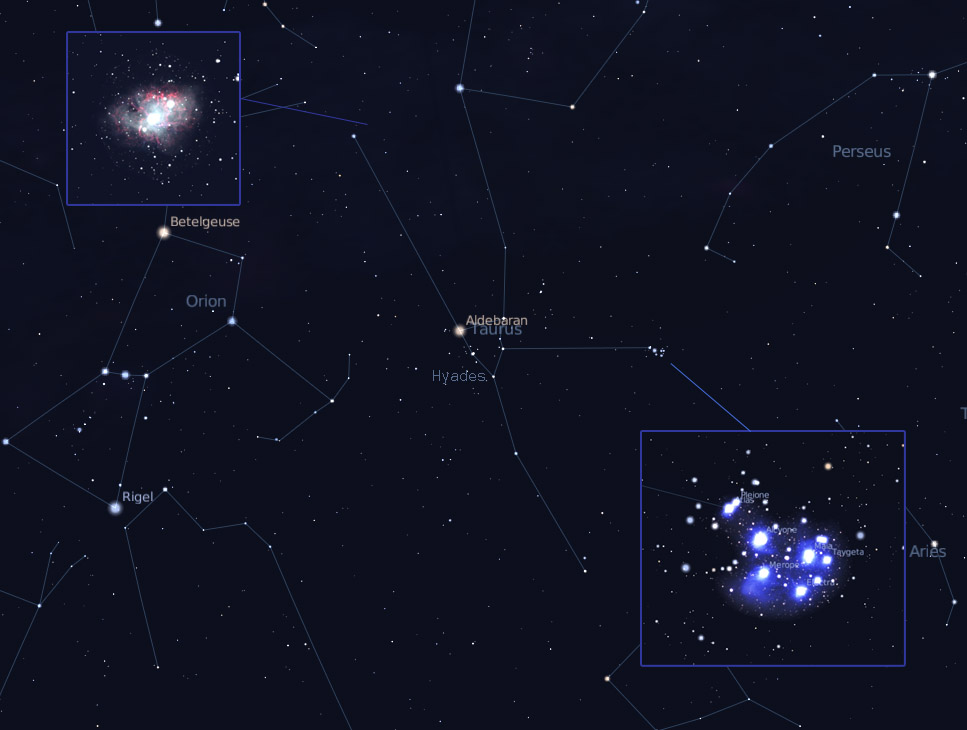 |
| Taurus, M1, Hyades and the Pleiades. |
Tuesday, February 1, 2011
2011 Constellation Guide: Orion
Orion

- Symbolism: Orion, the Hunter
- Main Stars: 7
- Right Ascension: 5 hours
- Declination: 5 degrees
- Visible between latitudes 85 and -75 degrees
- Best seen in January (at 9:00 PM)
Named Stars
- Betelgeuse (Alpha Ori)
- Rigel (Beta Ori)
- Bellatrix (Gamma Ori)
- Mintaka (Delta Ori)
- Alnilam (Epsilon Ori)
- Alnitak (Zeta Ori)
- Saiph(Kappa Ori)
Messier Objects
- M42 The Great Orion Nebula (diffuse nebula)
- M43 part of the Orion Nebula, de Mairan's Nebula (diffuse nebula)
- M78 (diffuse nebula)
Meteor Showers
- Orionids
- Around October 21st annually , the Orionid meteor shower reaches its peak. The meteors originate from Orion's border with Gemini. The zenithal hourly rate is about 20.
- Chi Orionids
- Peaks around December 2nd with a ZHR of about 3.
Mythology
The Greek poet Hesiod says that Orion was the son of Euryale, the daughter of Minos, and of Poseidon, and that there was given him as a gift the power of walking upon the waves as though upon land. When he was come to Chios, he outraged Merope, the daughter of Oenopion, being drunken; but Oenopion when he learned of it was greatly vexed at the outrage and blinded him and cast him out of the country. Then he came to Lemnos as a beggar and there met Hephaestus who took pity on him and gave him Cedalion his own servant to guide him. So Orion took Cedalion upon his shoulders and used to carry him about while he pointed out the roads. Then he came to the east and appears to have met Helius (the Sun) and to have been healed, and so returned back again to Oenopion to punish him; but Oenopion was hidden away by his people underground. Being disappointed, then, in his search for the king, Orion went away to Crete and spent his time hunting in company with Artemis and Leto. It seems that he threatened to kill every beast there was on earth; whereupon, in her anger, Earth sent up against him a scorpion of very great size by which he was stung and so perished. After this Zeus, at one prayer of Artemis and Leto, put him among the stars, because of his manliness, and the scorpion also as a memorial of him and of what had occurred.Features
Orion is one of the most recognizable constellations in the sky, home to some of the brightest stars, and a few deep-sky objects, most notably the Orion Nebula. You can easily locate Orion by looking southward to his right shoulder; Betelgeuse, a variable red supergiant, averaging around the 9th brightest star in the sky, and the 2nd brightest in the constellation. Going west to his left shoulder is Bellatrix, the 3rd brightest star in Orion. Bellatrix is the 27th brightest star in the sky. It is also known as the Amazon Star. It was once thought to belong to the same group as the stars of Orion’s belt; Alnitak, Alnilam, and Mintaka, but this is no longer believed to be the case. Looking southwest to the left foot is Rigel, the brightest star in the constellation and the 6th brightest in the sky. Across to the east you’ll find the right foot; Saiph. The name is from the Arabic saif al jabbar; sword of the giant.Crossing Orion’s waist from east to west is Alnitak, Alnihim and Mintaka; together this group creates Orion’s Belt. These stars may also be named the Three Kings or the Three Marys. They also mark the northern night sky when the sun is at its lowest point, and were a clear marker for ancient timekeeping. Hanging from Orion’s Belt is his sword; containing the breathtaking Orion Nebula. This is one of the brightest nebulae in the sky, and can be viewed by the unaided eye. It is also an active star forming region; new stars are currently being born there. The most notable feature of the Orion Nebula is the Trapezium. This is a tight open cluster of stars right in the center of the nebula. If you can resolve the 5 major stars of this cluster, you have very good seeing.
The Horsehead Nebula is located just south of Alnitak. It is a dark nebula; a cloud so dense that it blocks the light behind it. The nebula was given its name due to the shape that the swirling gas and dust form; it looks like a horses head! The red glow comes from the hydrogen gas reflecting the light from the nearby star Sigma Orionis. There are also new stars forming in this nebula.
 |
| Looking south to Orion. Orion and Horsehead Nebula enlarged. |
2011 Constellation Guide
It's been far too long since my last post. I've spent time working on other projects and spending time with my daughter. I did however, come up with a new idea for this blog which will help keep my posts somewhat regular, at least monthly. I'm going to post month-by-month a guide to the major northern constellations. There are plenty of us new and experienced sky watchers who may be familiar with deep-sky objects and star hoping, but perhaps don't really know the constellations, their stories, and what treasures lie within their boundaries. Therefore, each month I will present one or more constellations which can be best viewed by 9:00 PM for the corresponding month. Why 9:00 PM? That should be about when the constellation will be at its highest in the sky (locally) - it's much easier to view that way. Now, It's already February, so I'm already behind. I will soon post about our first constellation; Orion.
Thursday, September 30, 2010
Autumn Observing
I think autumn is my favorite season. The weather cools off just enough so that you don't have to sweat outside. The air temp is just right so that you can shut off the AC and open all the windows in the house, and the leaves on the trees begin to turn beautiful shades of red, orange and yellow. But the nights; the nights get a chill in the air, the humidity lifts, the sun sets earlier and the sky gets darker as the sun dips ever further beyond the horizon.
It seems the entire past week has been nothing but clouds and rain, so it goes without saying that there's pretty much been no observing. The exception would be just a few minutes of observing some variable stars for reporting to the AAVSO. If you have clear skies, take advantage and get out there. Jupiter is up over the horizon around 7:30 PM nowadays, so no excuses; and be sure to see Uranus nearby. You'll at least need binoculars to see Uranus. With an 8" mirror you can easily resolve the blue planet - pretty cool (I've seen all 8 of our planets in the scope this year). Don't forget to look for Comet Hartley 2 while you're out there.
 With Cassiopeia high in the sky after dark, this season is a good one to see such objects as the Double Cluster in Casseiopsia (a naked eye object if your skies are dark enough) and the Andromeda Galaxy (also a naked eye object, how cool!). Check out Cygnus, in which you can find open clusters M29 and M39. The Milky Way is also right overhead after dark, and once you let your eyes dark adapt, lay down and just stare upward, it's such an amazing sight - you'll probably spot a few meteors while you're at it.
Speaking of meteors, late in October we'll have the Orionids meteor shower (as well as the Hunter's Moon); not as spectacular as the Perseids, but we had clouds on the Perseids maximum night, so I'm really looking forward to this next shower. I'll post more details about this shower at a later date.
Enjoy these Autumn nights (hopefully without the rain).
It seems the entire past week has been nothing but clouds and rain, so it goes without saying that there's pretty much been no observing. The exception would be just a few minutes of observing some variable stars for reporting to the AAVSO. If you have clear skies, take advantage and get out there. Jupiter is up over the horizon around 7:30 PM nowadays, so no excuses; and be sure to see Uranus nearby. You'll at least need binoculars to see Uranus. With an 8" mirror you can easily resolve the blue planet - pretty cool (I've seen all 8 of our planets in the scope this year). Don't forget to look for Comet Hartley 2 while you're out there.

Speaking of meteors, late in October we'll have the Orionids meteor shower (as well as the Hunter's Moon); not as spectacular as the Perseids, but we had clouds on the Perseids maximum night, so I'm really looking forward to this next shower. I'll post more details about this shower at a later date.
Enjoy these Autumn nights (hopefully without the rain).
Tuesday, September 21, 2010
Comet Hartley 2 Returns
If you missed Comet McNaught this year, you'll have another chance (and a better one at that) to see a comet as Hartley 2 will come within 11 million miles of Earth on October 20. This comet was discovered by Malcolm Hartley in 1986 and has an orbital period of 6.46 years. Hartley 2 should be viewable by unaided eye in most moderately dark locations, estimated to reach around magnitude 5. This should be an easy find in binoculars. Tonight the comet is just above M31 in Andromeda, and will move northward below alpha Cassiopei by October 1. Go out and find it!
 |
| Path of Comet Hartley 2 through late October (Sky and Telescope) |
Thursday, August 26, 2010
A Moment with the Universe
I felt compelled to share this.
It was 10:10 PM last night. I had decided to take a break from the computer and walked upstairs to grab myself a drink. Entering the dark kitchen, I noticed the pale blue moonlight pouring across the floor, gently bathing the room in a soft lunar glow - I smiled and approached the window and tilted my head upward. I gazed in wonder as my eyes settled upon Jove and Luna, which hung so majestically between a gap in the treeline. In that very moment, a meteor streaked eastward, passing between the two. It was magical.
Moments like these are my reward for looking toward the night sky. They allow me a unique glimpse of the universe; to feel connected to it (as we so often don't in our modern lives), and to feel humbled.
Thursday, August 19, 2010
Moon Report 8/19
Tonight's forecast finally called for a cloud free sky, and I couldn't wait to get out and sight up the moon. The humidity was a little higher than ideal; 75%. The view was a tad hazy, and a faint glow could be seen around the moon, but the air was pretty still. I started setting up about 8:30; no reason to wait until complete darkness to view the moon.
 It wasn't but a few minutes until I heard the buzzing of mosquitoes - talk about a party crasher. I went out without bug repellent and didn't set up any fans; I wasn't planning on staying out long anyway. I did, however, get some satisfying scope time identifying some of the major features using the map at InOMN. Copernicus and Tycho looked great, and the Apennine Mountain range was a real pleasure. I didn't last for more than 10 minutes, the mosquitoes were too much to deal with (btw, Burt's Bees Outdoor Bug Bite Relief works great). I did manage to snap a few photos of Luna before heading in. 29 days until InOMN!

 It wasn't but a few minutes until I heard the buzzing of mosquitoes - talk about a party crasher. I went out without bug repellent and didn't set up any fans; I wasn't planning on staying out long anyway. I did, however, get some satisfying scope time identifying some of the major features using the map at InOMN. Copernicus and Tycho looked great, and the Apennine Mountain range was a real pleasure. I didn't last for more than 10 minutes, the mosquitoes were too much to deal with (btw, Burt's Bees Outdoor Bug Bite Relief works great). I did manage to snap a few photos of Luna before heading in. 29 days until InOMN!
Subscribe to:
Posts (Atom)